
When manufacturers think about metal distortion, laser cutting is often the first process that comes to mind. The heat generated during cutting can introduce internal stresses that reveal themselves later during bending, welding or assembly.
However, laser cutting isn’t the only process capable of affecting material stability.
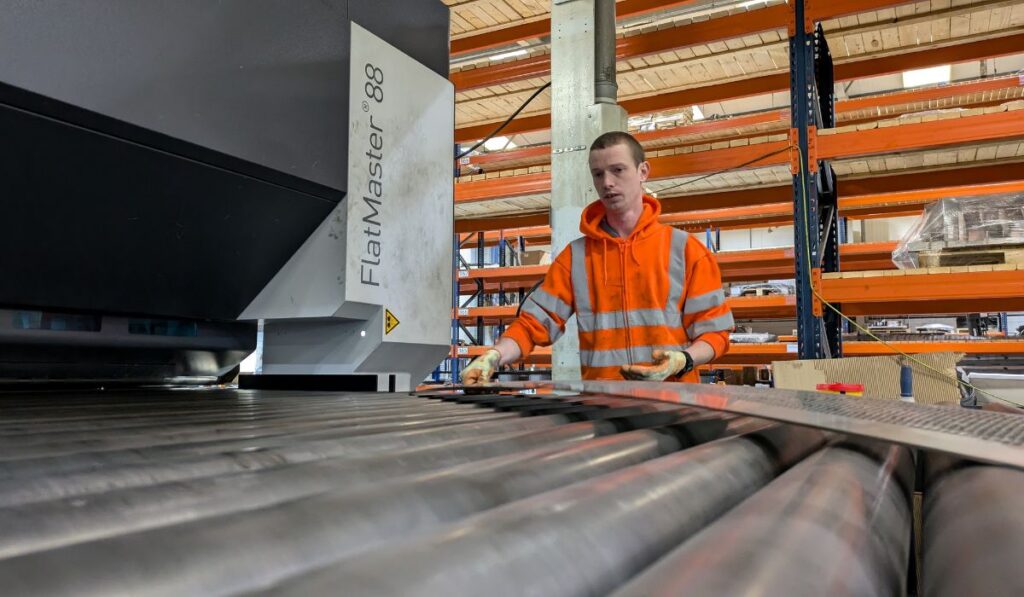
Punching is widely used to produce ventilation panels, decorative screens, filters and architectural components because it is fast, accurate and cost-effective. Although the process generates very little heat, the repeated mechanical force applied as thousands of holes or patterns are punched into the sheet can introduce stress into the material. On larger panels, or those with dense punched patterns, this can result in noticeable bowing or distortion.
That was the challenge facing one of our customers, who manufactures panels for industrial ventilation systems. The punched features met the required specification, but the finished panels no longer remained perfectly flat, creating additional challenges for downstream fabrication and final assembly.
To resolve the issue, the panels were processed through Wrightform’s large-format industrial metal levelling machine. Rather than simply flattening the surface, the controlled roller levelling process redistributed the internal stresses created during punching, producing flat, dimensionally stable panels while preserving the accuracy of every punched feature.
The difference was immediately apparent. The panels behaved more predictably during fabrication, fitted together more consistently and reduced the need for adjustment during assembly. Instead of compensating for distorted material, the customer could continue manufacturing with confidence, knowing each panel was flat and stress free before moving to the next stage.
Projects such as this demonstrate that industrial metal levelling isn’t just beneficial after laser cutting. Manufacturers producing punched, perforated and decorative sheet metal can experience many of the same downstream challenges, particularly where appearance, dimensional accuracy and repeatability are critical.
As demand continues to grow for architectural panels, ventilation systems and precision-engineered sheet metal, industrial levelling is becoming an increasingly valuable part of the manufacturing process, helping improve bending, welding, machining and assembly while reducing rework and improving overall product quality.
To find out more about our industrial metal levelling service, visit www.wrightform.co.uk/services/metal-flattening/. If you’re attending UK Metals Expo on 4th and 5th November, come and meet the Wrightform team on Stand F86, where we’ll be demonstrating real before-and-after examples of metal levelling and de-stressing and discussing how stress-free metal can improve your manufacturing process.


